The allure of van life and off-grid exploration is stronger than ever, but the financial reality of acquiring an adventure vehicle has shifted in 2026. After a few years of elevated borrowing costs, the market is stabilizing — and buyers have gotten sharper. Today’s van buyer is no longer willing to absorb steep depreciation and massive 20-year debt burdens on cookie-cutter Class B RVs that lose a third of their value the moment they leave the lot.
The smarter approach in 2026: a vehicle engineered for the long haul, built with precision, and financed intelligently. At Highland Vans, we build Sprinter conversions that compete head-to-head with the big-box manufacturers on price — but deliver dramatically better materials, engineering, and long-term value retention. Paired with the right financing strategy, our foundational builds give you a premium adventure vehicle without the financial hangover.
Here is everything you need to know about navigating camper van financing, avoiding costly lending mistakes, and understanding how the 2026 tax code may work in your favor.
The Hidden Truth About Camper Van Financing: RV Loans vs. Personal Loans
When it comes to financing a custom camper van, the biggest hurdle isn’t your credit score — it’s how the bank values the vehicle.
Traditional banks and credit unions rely heavily on the National Automobile Dealers Association (NADA) guide to determine a vehicle’s collateral value. Because fully custom, one-of-one boutique vans don’t exist in the NADA database, lenders have historically rejected these loan applications outright, viewing bespoke interior modifications as an unsecured risk.
When traditional secured RV financing falls through, many buyers are pushed into unsecured personal loans through online platforms like SoFi or LightStream. This is a costly mistake. Unsecured personal loans typically carry Annual Percentage Rates (APRs) of 12% or higher, combined with aggressive, short-term repayment schedules that inflate your monthly payments and can make a build financially impractical.
| Loan Type | Typical APR | Term Length | Best For |
| Secured RV Loan (e.g., through IntoRV) | 6.5%–8.0% | 10–20 years | Highland Vans buyers and other NADA-listed or lender-approved vehicles |
| Credit Union RV Loan | 6.0%–7.5% | 10–15 years | Members with relationship discounts |
| Unsecured Personal Loan | 12%+ | 3–7 years | Last resort — avoid if possible |
Why Banks Are Getting Comfortable with Boutique Builders
Here’s the shift happening in 2026: lenders are catching on that not all custom vans are created equal. Banks and credit unions are increasingly willing to finance builds from established boutique builders — and the reason is resale value.
Big-box manufacturers push volume. They use particle board cabinetry, proprietary components, and generic interior layouts designed to maximize factory throughput, not durability. These vans depreciate aggressively because the materials simply don’t last, and replacement parts often lock you into the original manufacturer’s ecosystem.
Our approach is fundamentally different. Laser-cut, CNC-bent 8020 aluminum-framed cabinetry paired with premium Victron electrical components and Lithionics lithium batteries creates a van that retains real value on the secondary market. Lenders see that. When the collateral holds its value, the loan is lower risk — and that translates to better terms for you.
As Highland Vans progresses toward RVIA certification, this dynamic will accelerate further, giving credit unions and specialized lenders even more confidence in our builds as bankable collateral.
Secured RV Loans: The Gold Standard — And We Offer Them Directly
Secured RV loans remain the most favorable financing path. Borrowers with strong credit (typically 680 and above) can currently access APR bands between roughly 6.5% and 8.0%, spreading manageable payments over 10 to 20 years.
That’s exactly why we’ve partnered with IntoRV, a lender that specializes in RV and adventure vehicle financing, to offer secured RV loans directly on our builds. Instead of scrambling to convince a traditional bank that your custom Sprinter conversion is a legitimate asset, you can apply for financing as part of your Highland Vans build process — through a lender that already understands the value of purpose-built adventure vehicles.
This eliminates the NADA valuation gap that pushes so many buyers into high-interest personal loans. Because we offer standardized, spec-built layouts with durable materials and institutional-grade components, IntoRV can confidently underwrite our builds as secured collateral — streamlining the path from design to delivery with loan terms tailored specifically to custom van conversions.
Ready to see what you qualify for? Contact our team directly to walk through the financing process with IntoRV.
The “Foundational Van” Concept: Finance the Base, Cash-Flow the Upgrades
As we explored in our guide to choosing a camper van in 2026, financial prudence means you don’t need to finance a fully loaded luxury rig on day one.
This is where the “foundational build” strategy comes in. Instead of locking you into a static, top-trim-only vehicle, we offer meticulously engineered foundational layouts at price points that compete directly with the big-box builders:
- The Elias (Starting at $135,000): The ideal baseline for the digital nomad, featuring an extended chef’s kitchen and a dedicated multifunction workspace.
- The Aoraki (Starting at $145,000): Optimized for couples and small groups, featuring multi-functional collapsible seating that seats four and sleeps two.
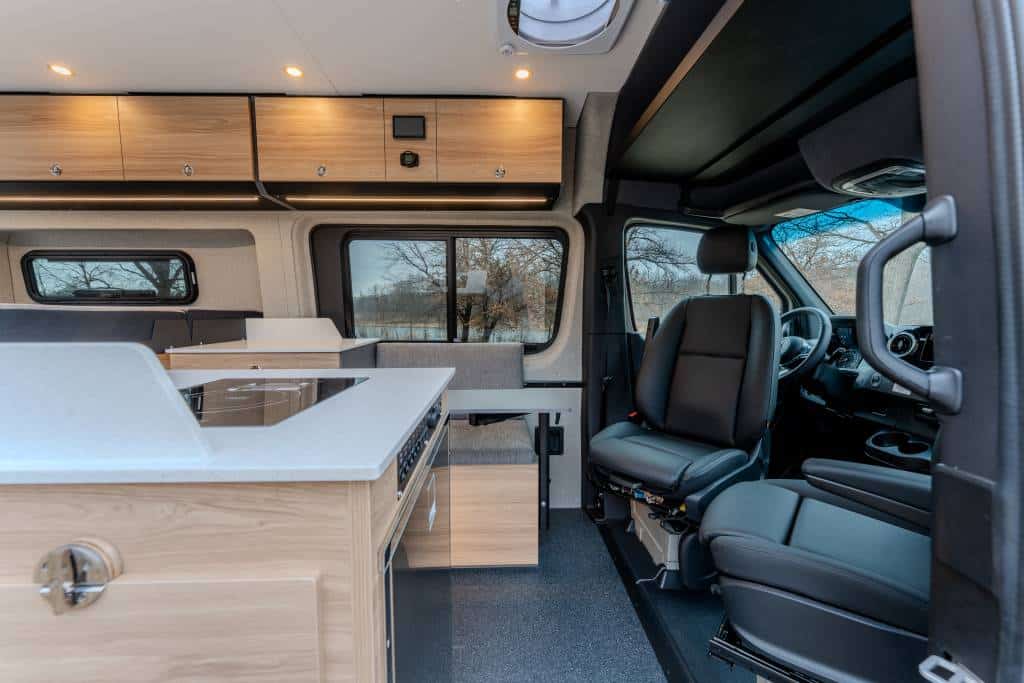
The difference is what you get for that money. Where a big-box competitor delivers particle board interiors at a similar price point, Highland Vans delivers aluminum-framed cabinetry, baltic birch panels, premium electrical systems, and extensive L-track mounting throughout. The result is a van built to last decades — not just the length of your loan.
This engineering also serves as a powerful financial tool. The extreme modularity of our aluminum and L-track systems allows you to finance the expensive “bones” of the van — the Mercedes Sprinter chassis, insulation, core electrical, and cabinetry — at a favorable RV loan interest rate. Our foundational builds are designed so the costly, precision-engineered systems are included from day one, while the accessories that enhance your experience can be added on your timeline.
Upgrades you can cash-flow later instead of rolling into a 15-year loan:
- Aftermarket wheels and all-terrain tires
- Front/rear bumpers with integrated lighting
- Rear-mounted swing-out tire carrier
- Winch and recovery gear
Understanding 2026 Tax Considerations for Van Owners
Understanding the current tax landscape can help reduce your total cost of ownership — but tax law is nuanced, and the right strategy depends entirely on your individual financial situation. Below are some provisions worth discussing with your CPA.
The Solar Reality Check
If you’ve read that you can claim a 30% federal Residential Clean Energy Credit on your van’s solar setup, that information is outdated. The Section 25D residential credit expired for systems placed in service after December 31, 2025. There is no phase-down — it simply ended.
Because rooftop solar on a van was already a marginal proposition from a credit perspective, the smarter off-grid strategy in 2026 is investing in high-efficiency alternator charging. We power our vans with premium Victron and Lithionics components, paired with a Nations secondary alternator, to keep your lithium batteries topped off while driving — no panels required, no expired credits to chase.
The Second Home Interest Deduction
The IRS allows you to classify an RV as a second home, which may enable you to deduct the loan’s interest on Schedule A, just like a residential mortgage. However, there are several important requirements to be aware of:
The van must have independent sleeping, cooking, and toilet facilities. By adding the Highland Vans Laveo dry-flush toilet upgrade to your foundational build, you satisfy the IRS sanitary requirement. This small investment could unlock the ability to deduct loan interest over the life of your financing.
Critical caveats your CPA will want to review:
- The loan must be secured by the RV itself (personal loans do not qualify)
- The combined mortgage debt on your primary and secondary residence cannot exceed $750,000
- You must itemize your deductions on Schedule A — with the 2026 standard deduction set at $16,100 for single filers and $32,200 for joint filers, many buyers will find that their total itemized deductions don’t exceed the standard deduction threshold, which means the interest deduction provides no actual tax benefit
Run the numbers with your CPA before factoring this into your purchase decision.
Section 179 for Business Use
If you use your van as a mobile office or business asset for more than 50% of the time, you may be eligible for Section 179 and bonus depreciation provisions. This could allow you to deduct portions of the van’s purchase price and operating costs. Maintain rigorous mileage logs to clearly distinguish between personal recreation and business use, and work with a CPA experienced in mobile business deductions — this area is a common audit trigger.
Why Highland Vans Is Disrupting the Market on Value
The legacy playbook in this industry works like this: massive manufacturers push builds into the $230,000 to $300,000+ range using commodity materials, then advertise $15,000 rebates to create the illusion of a deal. But applying a modest discount to an inflated MSRP still leaves you financing a vehicle built with particle board cabinetry and proprietary systems that will depreciate aggressively.
We compete at the price points where most buyers are actually shopping — and deliver a fundamentally different product for the money. A complete Elias build, including a base Mercedes Sprinter chassis, comes in well under $150,000. That’s competitive with what the big-box manufacturers charge for their entry-level Sprinter conversions. The difference is what’s behind the panels.
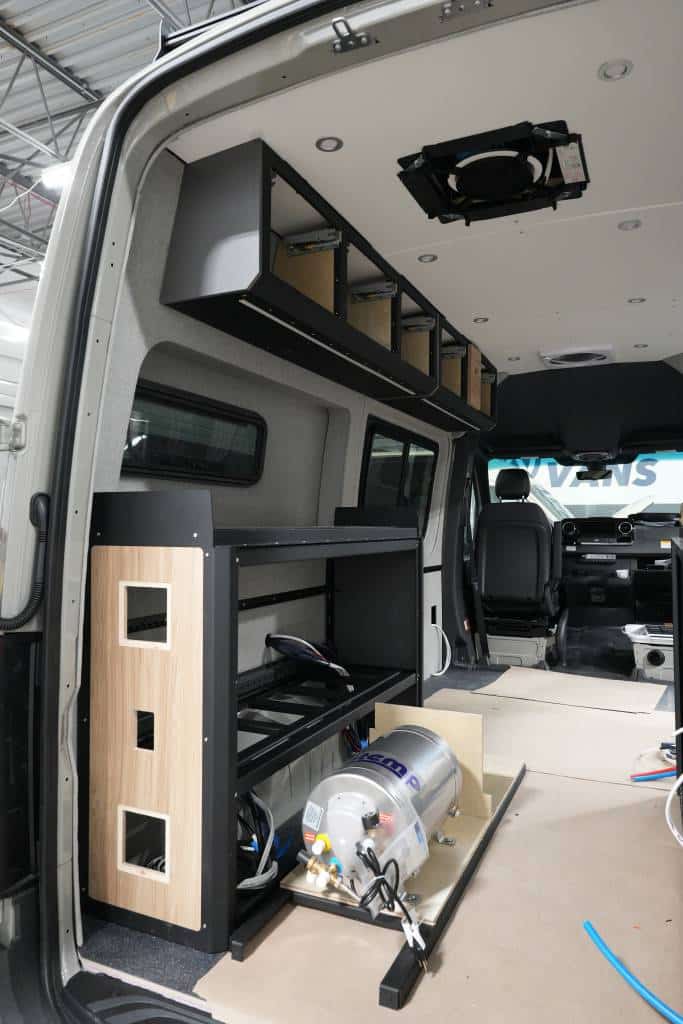
Our builds use laser-cut, CNC-bent 8020 aluminum framing and baltic birch plywood instead of particle board. Victron power electronics instead of off-brand inverters. Lithionics lithium batteries instead of generic cells. Every component is selected for longevity, serviceability, and open-standard compatibility — meaning you’re never locked into a proprietary ecosystem for parts or repairs.
This isn’t about being the cheapest option on the market. It’s about being the smartest investment. A Highland Vans build holds its value because the materials and engineering endure. When lenders evaluate our vans as collateral, they see a durable asset. When you eventually sell or trade up, the next buyer sees the same thing. That’s the financial advantage of building it right the first time.
Next Steps: Securing Your Build
Optimize your credit. A credit score above 680 opens access to the most favorable secured RV loan rates. If you’re not there yet, prioritize paying down revolving debt and avoiding new credit inquiries in the months before you apply.
Talk to local credit unions. Credit unions frequently offer relationship discounts — a 0.25% rate reduction if you maintain an active checking account or set up direct deposit can save you thousands over the life of a 12-year loan.
Consult your CPA. Before making any assumptions about tax deductions, review your specific financial situation with a qualified tax professional. The provisions discussed in this article may or may not apply to your circumstances.
Ask about our financing. We offer secured RV loans directly through our financing partner IntoRV — no need to hunt for a lender who understands custom van conversions. Ask our team to walk you through the application process.
Start the conversation with us. Ready to explore a build that makes financial sense? Check out our Aoraki and Elias virtual tours, visualize your modular upgrades, and contact our design team at (866) 751-7358 to start building a premium adventure vehicle engineered to hold its value.